

Is E85 Safe for Stock Engines? What You Need to Know
October 20, 2026

Table of Contents
- Is E85 Safe for Stock Engines? The Short Answer
- E85 in a Regular Gas Car: What Changes Under the Hood
- E85 Fuel System Compatibility: Lines, Seals, Pumps, and Injectors
- How E85 Affects Fuel Economy and Power Output
- When You Need an E85 Conversion Kit (and What It Does)
- Stock Engine Decision Guide: Which Vehicles Can Run E85
- What to Do After Accidentally Filling a Non-Flex-Fuel Car With E85
- Conclusion
- Frequently Asked Questions
Last Updated: October 21, 2026
Is E85 Safe for Stock Engines? The Short Answer
Is E85 safe for stock engines? For a factory flex-fuel vehicle, yes. For a standard gasoline-only car, no, not without changes. That single distinction decides everything that follows.
At Advanced Fuel Dynamics, we build flex fuel hardware for a living. The confusion comes from one word: "stock." A stock flex-fuel truck and a stock gasoline-only sedan are both stock, yet only one is built to burn ethanol blends safely.

Below, we explain what actually changes under the hood, which parts take the stress, and how to check your own vehicle before you fill up.
E85 in a Regular Gas Car: What Changes Under the Hood
E85 is a fuel blend of roughly 51% to 83% ethanol, with the rest gasoline. That ethanol share changes how the engine must be fed. The U.S. Department of Energy's alternative fuels data center tracks how widely these blends are sold and how the seasonal mix shifts.
Two problems appear in a gasoline-only car: the wrong air-fuel ratio and not enough fuel volume.
Air-Fuel Ratio and the Lean Condition Risk
Gasoline burns best near a 14.7:1 air-fuel ratio. E85 needs closer to 9.8:1. A stock ECU has no way to know ethanol content, so it keeps feeding gasoline-sized fuel doses. The result is a lean condition: too much air, too little fuel.
Lean running raises combustion temperatures. Left alone, that can lead to detonation, misfire, and in bad cases, piston damage.
Fuel Delivery Capacity and Increased Demand
E85 also demands more volume. You need roughly 30% more fuel to make the same power. Stock injectors and pumps on a gasoline-only car often have no headroom for that.
So the honest answer to "is E85 safe for stock engines" depends on whether the fuel system was sized for it at the factory.
E85 Fuel System Compatibility: Lines, Seals, Pumps, and Injectors
E85 fuel system compatibility comes down to two things: materials that resist ethanol and capacity to move roughly 30% more volume. Ethanol is a solvent and a hygroscopic compound, meaning it absorbs moisture from the air. That combination stresses every wetted surface in the fuel system, and the stress shows up differently depending on the part.
Here is what actually matters, part by part:
- Fuel lines: Modern OEM lines are typically nylon, PTFE, or ethanol-rated rubber and handle E85 well. Older rubber lines, especially pre-1990s compounds, can soften, swell, or shed material internally. A line that swells can restrict flow; one that sheds can clog the filter and injectors.
- Seals and gaskets: Viton and other fluorocarbon elastomers are standard on flex-fuel builds. Nitrile and natural rubber seals in older or budget components are the usual failure point, showing up as seeps at the fuel rail, sender, or pump housing.
- Fuel pump: The pump must move about 30% more volume at the same pressure. A stock gasoline pump near its flow limit will lose pressure at high load, which shows up as a lean condition exactly when the engine is working hardest.
- Fuel injectors: Injector capacity must cover the higher demand. Upgrading injectors without upgrading the pump just moves the bottleneck downstream; the pump becomes the limit and the engine still leans out up top.
- Fuel tank: Steel tanks in older vehicles are more prone to corrosion because ethanol absorbs water and holds it against the metal. Plastic and stainless tanks are far less affected.
- Fuel filter: E85 can loosen deposits left by gasoline, so a filter change shortly after switching is a common precaution.
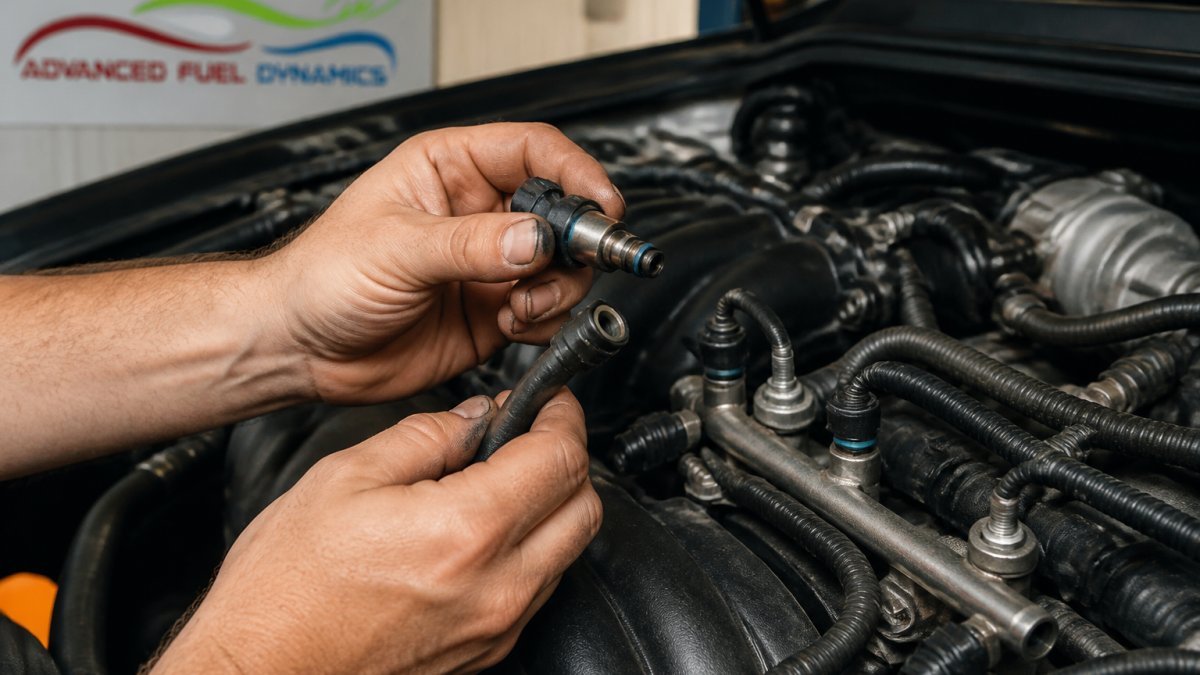
A practical inspection order for a gasoline-only car you are considering converting: check the fuel door and owner's manual first, then inspect lines and seals at the rail and tank, then confirm pump and injector flow capacity against the engine's demand. Most practitioners find the pump and injectors are the first real limits, not the lines.
Watch Out
Running E85 through a fuel system sized only for gasoline can push injector duty cycle to its limit. The consequence is a lean condition under load, exactly when the engine is working hardest. Watch for a check-engine light, misfire, or a fuel smell after a fill as early warning signs.
How E85 Affects Fuel Economy and Power Output
E85 fuel economy drops, and that surprises people. Because you burn more volume, miles per gallon typically fall by around 25% to 30% versus gasoline. That is normal, not a fault.
Power output moves the other way. Ethanol has a higher octane rating and a cooling effect in the chamber, which lets an engine run more timing before knock. On a properly calibrated flex-fuel setup, that means more power. Optimizing these combustion dynamics requires a deeper understanding of how modern bioethanol fuel influences long-term engine health and performance parameters.
The catch: a gasoline-only car can't use that octane. Without calibration, it just runs lean and loses efficiency.
When You Need an E85 Conversion Kit (and What It Does)
You need an E85 conversion kit when your vehicle is not factory flex-fuel but you want to run ethanol blends safely. A conversion kit adds ethanol sensing and lets the ECU adjust fuel and timing in real time.
Our approach at Advanced Fuel Dynamics is plug-and-play. The EPA's guidance on ethanol and flex-fuel vehicles is a useful starting point for understanding how flex-fuel status is defined.
A kit does three jobs:
- Reads ethanol content at the pump.
- Adjusts fuel delivery to match.
- Keeps the tune safe as the blend changes.
That last point matters because pump ethanol content is not fixed.
Verifying Ethanol Content at the Pump
Ethanol content varies by season and station. A "flex fuel" pump in winter may carry far less ethanol than in summer. You cannot assume the label tells the whole story.
GM/Continental E85 FlexFuel sensor →
A content sensor removes the guesswork. Our E-SENSE E85 Flex Fuel Content Sensor reads ethanol percentage and fuel temperature in real time, so the system adjusts as the blend shifts. For budget builds, the GM/Continental E85 FlexFuel sensor is a genuine Continental E85 flexfuel sensor.

Pro Tip
Check ethanol content before a track day or a long tow. A blend that reads high at one station can read much lower at the next, and your calibration has to follow it.
Stock Engine Decision Guide: Which Vehicles Can Run E85
Use this guide to sort your own vehicle before you touch a pump.
| Vehicle Type | Flex-Fuel From Factory? | Can Run E85 As-Is? | What to Do |
|---|---|---|---|
| Flex-fuel truck or SUV (badge or yellow cap) | Yes | Yes | Fill up and drive |
| Gasoline-only car, any year | No | No | Add a conversion kit or skip E85 |
| Older carbureted vehicle | No | No | Not recommended without a full build |
| Performance car with a flex kit installed | No | Yes | Verify the kit is calibrated |
| Vehicle with unknown history | Check the manual | Check first | Confirm via VIN and owner's manual |
How to confirm flex-fuel status:
- Check the fuel door for a yellow cap or E85 label.
- Read the owner's manual for "flex fuel" wording.
- Look up the VIN with a dealer or manufacturer tool.
If none of those confirm it, treat the car as gasoline-only.
What to Do After Accidentally Filling a Non-Flex-Fuel Car With E85
Don't panic. A single tank of E85 in a gasoline-only car is usually survivable if you act quickly, and the right response depends on how much went in and how the car is running. Use this decision guide.
Step 1: Estimate how much E85 went in.
- A few gallons into a mostly full tank of gasoline is a low-concentration blend and rarely causes trouble.
- A full tank of E85 in a near-empty tank is the highest-risk case because the ethanol share is at its peak.
Step 2: Dilute with gasoline as soon as practical.
Top off with premium gasoline to lower the ethanol percentage. The faster you dilute, the lower the risk. If the tank is nearly full of E85, adding gasoline still helps, but plan a second fill once the tank drops.
Step 3: Match driving to the risk.
- Do not floor it, tow heavy loads, or run sustained high RPM.
- Drive gently and keep RPM low until the blend is diluted.
- Avoid long idles and hard acceleration from a stop.
Step 4: Watch for symptoms.
A check-engine light, misfire, rough idle, hesitation under load, or a fuel smell are signs the car is not compensating. If any appear, stop driving and have it inspected. A small blend in a near-empty tank is far less risky than a full tank of E85.
Step 5: Refill with gasoline again as soon as the tank drops.
Each gasoline fill lowers the ethanol share further. Two or three fills usually return the car to normal pump gasoline concentration.
Key Takeaway
The faster you dilute a mistaken E85 fill with gasoline, the lower the risk. Gentle driving and a quick top-off do most of the work, and symptoms, not the fuel label, tell you when to stop driving.
Conclusion
The real challenge with E85 is not the fuel itself. It is matching the fuel system and calibration to what comes out of the pump, blend by blend.
That is exactly what we build for. Advanced Fuel Dynamics systems adjust in real time to changing ethanol content, so you get consistent fuel delivery without custom tuning. Our FlexLink kit for stand-alone ECUs and the ProFlex DX for 2018-23 Mustang GT both deliver true plug-and-play flex fuel, tested in house and on the dyno.

Get started with Advanced Fuel Dynamics and run ethanol with confidence, not guesswork.
Frequently Asked Questions
Can you run E85 on a stock motor?
Only if the vehicle is factory flex-fuel rated. A stock engine built for gasoline lacks the calibration and often the fuel-system capacity to handle E85's higher demand. Running E85 in a non-flex-fuel stock engine can cause a lean condition, misfires, and a check-engine light. Check your owner's manual and fuel-door label first. If your car is not flex-fuel rated, a flex-fuel conversion system is the safer path before pumping E85.
What happens if you run E85 in a regular engine?
A regular gas engine calibrated for gasoline will run lean on E85 because the fuel requires more volume per combustion event. You may notice reduced fuel economy, rough idle, misfires, and a check-engine light. Prolonged lean running raises combustion temperatures and can damage pistons and valves. If you accidentally filled a gasoline-only car with E85, avoid heavy throttle, top off with premium gasoline to dilute the blend, and have the fuel system inspected if symptoms persist.
Can using E85 damage fuel injectors or fuel lines?
E85 is not inherently corrosive to modern fuel-system materials, but older rubber lines, seals, and gaskets may not be rated for high ethanol content. Injectors can also fall short on flow capacity because E85 demands roughly 30% more fuel volume. A proper E85 fuel system compatibility check covers lines, seals, pump capacity, and injector sizing. If any component is marginal on gasoline, E85 will expose it.
How can I tell if my car is compatible with E85?
Look for a flex-fuel badge, a yellow fuel cap, or a fuel-door label stating E85 or flex fuel. Check the owner's manual for the fuel recommendation and confirm the vehicle's engine code is listed as flex-fuel capable. You can also verify ethanol content at the pump using a flex-fuel sensor. If none of these confirm compatibility, treat the car as gasoline-only until a conversion kit is installed.