

How to Compare E85 and Premium Fuel Costs Per Mile
November 05, 2026

Last Updated: November 5, 2026
Quick Summary
To compare E85 and premium fuel cost per mile, divide each fuel's price per gallon by its miles per gallon and compare the two results. The lower figure is the cheaper fuel to run, and the break-even E85 price equals premium price times E85 MPG divided by premium MPG.
- Cost per mile equals price per gallon divided by miles per gallon, run once for each fuel.
- Break-even E85 price = premium price × (E85 MPG ÷ premium MPG), so $4.00 × (17 ÷ 24) is about $2.83.
- Measure your own MPG over two tanks per fuel, keeping the driving mix similar.
- E85 ethanol content commonly ranges from 51% to 83% depending on season and region.
- Using EPA window-sticker MPG instead of your own tank averages skews the break-even price.
Table of Contents
- Why Pump Price Alone Misleads You on E85 and Premium Fuel Cost
- What You'll Need Before You Calculate Cost Per Mile
- Step 1: Build Your E85 vs Regular Gas Calculator
- Step 2: Find the Break-Even Price for E85
- Is E85 Cheaper Than Premium? Running the Numbers
- E85 Fuel Economy Compared With Gasoline: What the MPG Gap Really Costs
- Flex-Fuel Vehicle E85 Compatibility and Premium Requirements
- Common Mistakes That Skew Your Cost-Per-Mile Estimate
- Frequently Asked Questions
Why Pump Price Alone Misleads You on E85 and Premium Fuel Cost
The number on the pump sign tells you almost nothing about what you actually spend to drive a mile. E85 and premium fuel cost comparisons live or die on a second number most drivers never check: how much fuel the engine burns to cover the same distance. Ethanol carries less energy per gallon than gasoline, so a flex-fuel vehicle burns more E85 to do the same work. Flex-fuel systems for trucks, SUVs and performance cars raise a common question: does the cheaper pump price actually save money?
What You'll Need Before You Calculate Cost Per Mile
Three inputs drive the whole calculation: the price per gallon of each fuel, the vehicle's miles per gallon on each fuel, and a realistic driving mix. Gather your owner's manual fuel requirement, your last few tank averages, and current pump prices from stations you actually use. Note that E85 is not premium gasoline. It is an ethanol blend, usually 51% to 83% ethanol depending on the season and region, per U.S. Department of Energy alternative fuels data. That blend variation matters later. Write your numbers down before you start, because guessing at MPG is the fastest way to a wrong answer.
Step 1: Build Your E85 vs Regular Gas Calculator
An E85 vs regular gas calculator is simple arithmetic, and you can run it on a phone in the staging area of a station. The core idea: divide price per gallon by miles per gallon to get cost per mile for each fuel, then compare the two figures side by side.
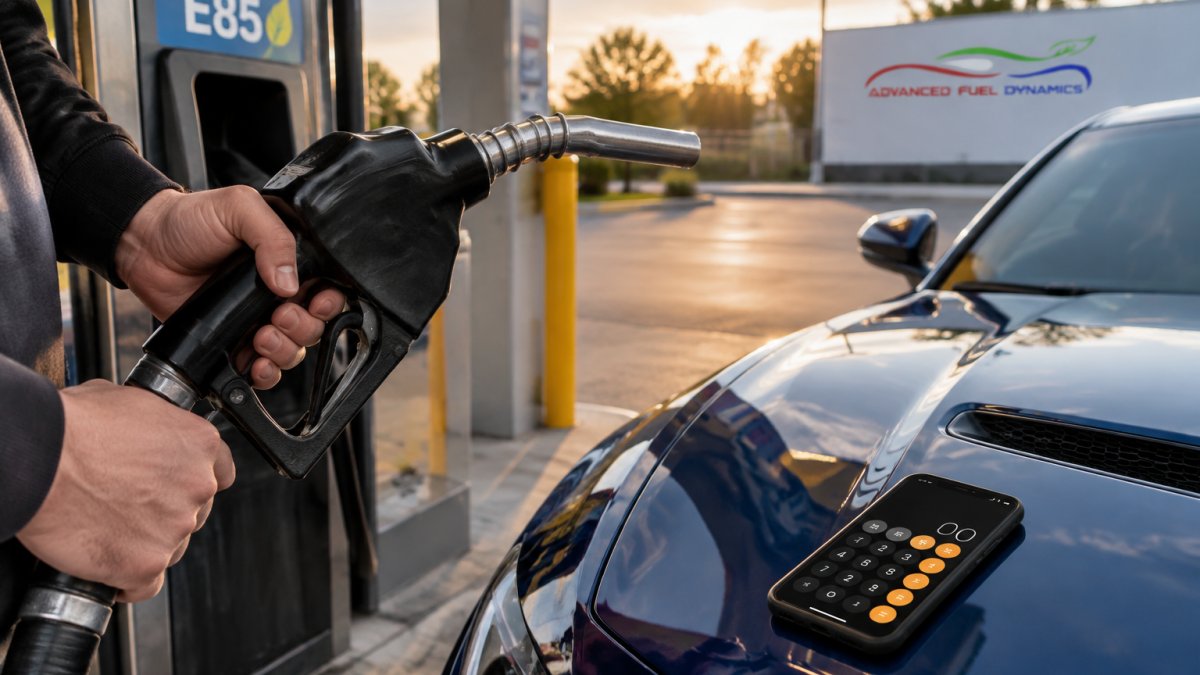
The Cost-Per-Mile Formula
Cost per mile = price per gallon ÷ miles per gallon.
Run it twice, once for E85 and once for premium. The lower result is the cheaper fuel to run, regardless of what the sign says.
A Worked Example With Current Prices
Suppose premium is $4.00 per gallon and your car returns 24 MPG on it. That is about $0.167 per mile. Now suppose E85 is $2.80 per gallon and the same car returns 17 MPG. That is about $0.165 per mile. E85 wins, but only barely, and only because the MPG loss stayed near 30%. Change either price by a few cents and the answer flips. That sensitivity is the whole story.
| Fuel | Price/Gallon | MPG | Cost Per Mile |
|---|---|---|---|
| Premium gasoline | $4.00 | 24 | $0.167 |
| E85 | $2.80 | 17 | $0.165 |
Step 2: Find the Break-Even Price for E85
The break-even price is the E85 pump price at which E85 and premium cost the same per mile. Above it, premium is cheaper to run; below it, E85 wins. The formula is short enough to memorize:
Break-even E85 price = premium price × (E85 MPG ÷ premium MPG)
Using the worked example from Step 1, $4.00 × (17 ÷ 24) equals about $2.83 per gallon. Any E85 price below that saves you money; anything above it costs you. This single number is the most useful figure in the whole exercise, because it stays valid as premium prices move, you only need to recalculate when your MPG averages shift.
Turn It Into a Reusable Calculator
You can build a one-line calculator in any spreadsheet or phone calculator app. Enter these four cells:
- Premium price per gallon (call it P).
- Premium MPG (call it M_prem).
- E85 MPG (call it M_e85).
- Break-even E85 price = P × (M_e85 ÷ M_prem).
Then add a fifth cell for the actual E85 pump price and a sixth for the difference: actual E85 price minus break-even price. A negative difference means E85 is cheaper per mile; a positive difference means premium is. This is the same arithmetic every time, so once the sheet is built you can update it at the pump in seconds.
See How Sensitive the Answer Is
The break-even price moves with both the premium price and the size of your MPG loss. The table below holds the E85 MPG loss constant at three common levels and shows how the break-even E85 price changes as premium moves.
| Premium price/gal | MPG loss 15% (E85 = 85% of premium MPG) | MPG loss 25% (E85 = 75% of premium MPG) | MPG loss 30% (E85 = 70% of premium MPG) |
|---|---|---|---|
| $3.50 | $2.98 | $2.63 | $2.45 |
| $4.00 | $3.40 | $3.00 | $2.80 |
| $4.50 | $3.83 | $3.38 | $3.15 |
| $5.00 | $4.25 | $3.75 | $3.50 |
Read the table this way: if premium is $4.00 and your E85 MPG loss is 25%, E85 must be priced below $3.00 per gallon to save you money per mile. If the pump shows $3.20, premium is the cheaper fuel to run even though E85 looks cheaper on the sign.
GM/Continental E85 FlexFuel sensor →
Recalculate When Your Inputs Change
The break-even figure is only as good as the MPG numbers behind it. Recalculate it whenever you change driving mix (more highway, more towing, a seasonal blend change) or when premium prices move by more than a few cents.
Watch out: using the EPA window-sticker MPG instead of your own tank averages will push the break-even price in the wrong direction, because the sticker figure rarely matches real-world E85 consumption.
Is E85 Cheaper Than Premium? Running the Numbers
E85 is often cheaper than premium per mile, but not automatically. The answer depends entirely on the size of the gap between the two pump prices and the size of your MPG loss. A common mistake is assuming the usual pump discount guarantees savings. In practice, if E85 sits close to premium at the pump, the energy penalty wipes out the advantage. If you want to log real ethanol content at the pump rather than trust the label, the FlexLink Flex Fuel E85 Ethanol Gauge provides a Bluetooth readout through the ProFlex Connect app.

E85 Fuel Economy Compared With Gasoline: What the MPG Gap Really Costs
E85 fuel economy compared with gasoline typically runs lower because ethanol contains less energy per gallon. MPG drops vary by vehicle, driving style and the ethanol blend in the tank. That range is wide enough that borrowing someone else's number is the fastest way to a wrong cost-per-mile estimate. The fix is a short measurement protocol and an honest treatment of the uncertainty.
Measure Your Own MPG Gap in Four Fill-Ups
You do not need a dyno to get a usable MPG figure. Run this sequence:
- Fill the tank on premium and reset the trip meter. Drive your normal mix until the tank is near empty.
- Refill on premium and record gallons added and miles driven. Divide miles by gallons for your premium MPG.
- Switch to E85, reset the trip meter, and drive a comparable mix until near empty.
- Refill on E85 and record gallons and miles the same way. Divide for your E85 MPG.
Two tanks on each fuel is better than one, because a single tank is a sample, not a verdict. Average the two tanks per fuel before you divide, and keep the driving mix similar between the premium and E85 legs or the comparison is not apples to apples.
What Actually Moves the MPG Gap
Five factors explain most of the variance drivers see:
- Ethanol blend. E85 is not a fixed recipe. The ethanol share commonly ranges from 51% to 83% depending on season and region, per U.S. Department of Energy alternative fuels data. A winter blend with less ethanol burns closer to gasoline, so the MPG loss shrinks.
- Route and speed. Highway cruising and stop-and-go city driving penalize the two fuels differently, so a mostly-highway tank will not predict a mostly-city tank.
- Load and towing. Heavier loads amplify the gallons burned, and the E85 penalty grows with them.
- Temperature. Cold starts and winter fuel formulations both shift consumption, which is why a summer measurement may not hold in January.
- Vehicle calibration. A flex-fuel vehicle that reads ethanol content and adjusts air/fuel mixture and ignition timing will land closer to its best case than a conversion running a generic calibration.
Treat the Result as a Range, Not a Number
Because the MPG gap is uncertain, the cost-per-mile answer is uncertain too. A practical approach is to compute cost per mile at both ends of your measured range, say, your best E85 tank and your worst, and see whether the conclusion holds at both. If E85 is cheaper at both ends, you can act on it.
Watch out: trusting a single tank, or a tank driven on a different route than the comparison tank, will make the MPG gap look larger or smaller than it really is and skew every downstream cost-per-mile figure.
Flex-Fuel Vehicle E85 Compatibility and Premium Requirements
Flex-fuel vehicle E85 compatibility is not universal, and premium-required engines add a wrinkle. A true flex-fuel vehicle carries a sensor that reads ethanol content and lets the ECU adjust air/fuel mixture and ignition timing. This is where hardware matters: our GM/Continental E85 FlexFuel sensor is the genuine content sensor many conversions use, while the patented E-SENSE E85 Flex Fuel Content Sensor offers a high-flow design for high-demand builds. Subaru owners can check the Forester XT flex-fuel kit or the WRX flex-fuel kit, and Pontiac G8 and Jeep Commander 5.7 Hemi owners have G8 and Commander collections built for their platforms.


Common Mistakes That Skew Your Cost-Per-Mile Estimate
A common error is comparing E85 against a fuel grade your engine does not require. The third is ignoring seasonal blend changes, since winter E85 carries less ethanol and behaves differently at the pump, as the U.S. Department of Energy ethanol blend guidance explains.
Comparing fuel costs per mile rewards the driver who measures instead of guesses. If you want that math to work in your favor, the hardware has to keep up with whatever ethanol blend the pump delivers.
Frequently Asked Questions
How much worse is MPG with E85?
E85 carries less energy per gallon than gasoline, so flex-fuel vehicles typically see a lower miles-per-gallon figure when running E85. The exact figure depends on your vehicle, driving style, and the actual ethanol content at the pump, which can range from E51 to E83. Measure your own MPG over at least two tanks before trusting any estimate.
How do you calculate fuel cost per mile?
Divide the price per gallon by the miles per gallon your vehicle achieves on that fuel. For example, at $4.00 per gallon and 25 MPG, your cost per mile is $0.16. Run the calculation separately for E85 and premium using each fuel's own pump price and its own MPG figure, then compare the two results. This E85 vs regular gas calculator method works for any vehicle and any fuel as long as you use consistent units.
How much cheaper does E85 need to be to offset lower fuel economy?
Multiply the premium price by the ratio of E85 MPG to premium MPG. If premium costs $4.20 per gallon and E85 delivers 75 percent of the MPG premium delivers, the break-even E85 price is $4.20 x 0.75, or $3.15 per gallon. Any E85 pump price below that number saves you money per mile. Above it, premium is the cheaper fuel despite the higher sticker price.
Can you use E85 in a vehicle designed for premium gasoline?
Only if the vehicle is a flex-fuel vehicle rated for E85 from the factory, or if it has been converted with a flex-fuel system that adjusts fueling for ethanol content. A car that requires premium but is not flex-fuel rated should not run E85, because the engine control module cannot compensate for the additional fuel volume ethanol demands. Check your owner's manual or fuel door label for the E85 designation before you plan any cost comparison.
