

E85 vs Race Gas for Occasional Track Days Compared
November 07, 2026

Last Updated: November 7, 2026
Quick Summary
E85 is an 85 percent ethanol fuel that suits many occasional track day drivers, while race gas remains the traditional choice for maximum knock resistance. In e85 vs race gas comparisons, the right pick depends on how often you run, how much you want to spend per event, and how your engine is set up.
- E85 can work well for a few track days a season with a properly sized fuel system.
- Race gas may keep things simpler for someone racing every weekend with a dedicated car.
- E85 needs more fuel volume than gasoline, so injectors and pumps must be sized for it.
- A flex-fuel sensor lets the ECU adjust as the ethanol blend changes at the pump.
- Confirm every wetted fuel system material is ethanol-compatible before running E85.
Ready to run E85 on track?Advanced Fuel Dynamics builds plug-and-play flex fuel sensors and pumps for ethanol-based power.
Contact Us
Table of Contents
- E85 vs Race Gas: The Short Answer for Occasional Track Days
- Power and Torque Output: How the Two Fuels Compare
- E85 vs. 110 Octane: Knock Resistance and Ignition Timing
- Pump E85 vs. Race E85: Ethanol Content and Consistency
- E85 Fuel System Requirements: Injectors, Pump and Fuel Volume
- E85 Fuel Consumption Compared with Gasoline and Cost Per Track Day
- Choosing the Right Fuel for Your Next Track Day
- Frequently Asked Questions
E85 vs Race Gas: The Short Answer for Occasional Track Days
When weighing e85 vs race gas, E85 is an 85 percent ethanol fuel, and for many occasional track day drivers it offers a strong mix of power and cost (Alternative Fuels Data Center: E85 (Flex Fuel)). Race gasoline, typically rated around 100 to 110 octane, remains the traditional choice for maximum knock resistance. The right pick depends on how often you run, how much you want to spend per event, and how your engine is set up.
E85 has a high octane rating and resists knock well, which lets a tuned engine run more boost or timing. Race gas delivers similar knock resistance without the fuel system changes ethanol demands.
For a few track days a season, E85 with a properly sized fuel system can make sense. For racing every weekend with a dedicated car, race gas may keep things simpler.
Power and Torque Output: How the Two Fuels Compare
Ethanol carries more oxygen than gasoline and has a higher latent heat of vaporization, which cools the intake charge. Those properties are why E85 can support more power in a suitably built engine. Gains depend on the tune, boost level, and hardware, so treat any single number as a starting point rather than a promise.
Race gas gives consistent results on engines calibrated for it. The difference can be most noticeable under boost and at higher loads.
The two fuels differ in several measurable properties that affect how an engine makes power.
| Property | E85 | Race gas |
|---|---|---|
| Typical octane rating | High octane, resists knock well | Around 100 to 110 octane |
| Oxygen content | Carries more oxygen than gasoline | Lower oxygen content |
| Latent heat of vaporization | Higher, cools the intake charge | Lower cooling effect |
| Power gain potential | Can support more power in a suitably built engine | Consistent results on calibrated engines |
| Most noticeable effect | Gains depend on tune, boost and hardware | Most noticeable under boost and high load |
E85 vs. 110 Octane: Knock Resistance and Ignition Timing
Knock, or detonation, happens when the air-fuel mixture ignites unevenly under pressure. Higher octane fuel resists knock, which lets the ECU advance ignition timing for more power. Both E85 and 110-octane race gas resist knock well, which is why both are popular on boosted street and track cars.
The practical difference comes down to how the engine responds when conditions change. Ethanol content varies at the pump, so an ECU tuned for one blend can run leaner or richer than expected on another. A flex-fuel sensor helps the system adjust as the blend changes.
Pump E85 vs. Race E85: Ethanol Content and Consistency
Pump E85 is sold as a blend, but the actual ethanol percentage can differ from station to station and season to season. Race E85 is usually sold with tighter specifications, which makes it more predictable. For occasional track days, that predictability matters because you may not have time to retune between events.
A flex-fuel sensor lets the system read the blend in real time. The E-Sense E85 Flex Fuel Content Sensor, priced at $249.00, reads ethanol content and fuel temperature and feeds that data to the engine management system.
E85 Fuel System Requirements: Injectors, Pump and Fuel Volume
E85 needs more fuel volume than gasoline for the same power, so the fuel system has to be sized for that extra volume at your target horsepower.
Work through the system in order:
- Injectors. Match injector flow to your target horsepower on E85, not gasoline. Larger injectors are often needed when converting to E85.
- Pump. A high-volume in-line or in-tank pump rated for ethanol is required once demand climbs. The High Efficiency EFI In Line Fuel Pump, priced at $827.60, is compatible with ethanol.
- Sensor and ECU input. A flex-fuel sensor lets the ECU read ethanol content and adjust fueling and timing as the blend changes. The GM/Continental E85 FlexFuel sensor is available for $59.00 and works with all major ECUs on the market. Stand-alone ECU users may prefer the FlexLink E85 flex fuel kit for Stand Alone ECUs at $459.00, which interprets sensor data into a format the ECU can use. The FlexLink Flex Fuel E85 Ethanol Gauge, at $299.00, provides a Bluetooth readout and wired output for logging. The E-Sense E85 Flex Fuel Content Sensor, priced at $249.00, reads ethanol content and fuel temperature and feeds that data to the engine management system.
- Lines, seals, and tank. Confirm every wetted material is ethanol-compatible. Older rubber lines and some seals degrade over time with ethanol exposure, and a car that sits between events gives those materials more time to soften.
Compatibility and storage matter for occasional track cars, because the car may sit for weeks or months between events. Ethanol absorbs water from the air, so fuel stored in a tank for long periods can be affected. Check fuel condition rather than assuming last season's fill is still good. Because stale or moisture-affected fuel can complicate octane choices, The Boost Pros can help frame the tradeoff between race fuel and octane booster when planning the next track day.

A tune calibrated for one ethanol blend may not suit another, and blend variation at the pump can change ethanol content across the year. A flex-fuel sensor can help the system respond to those changes.
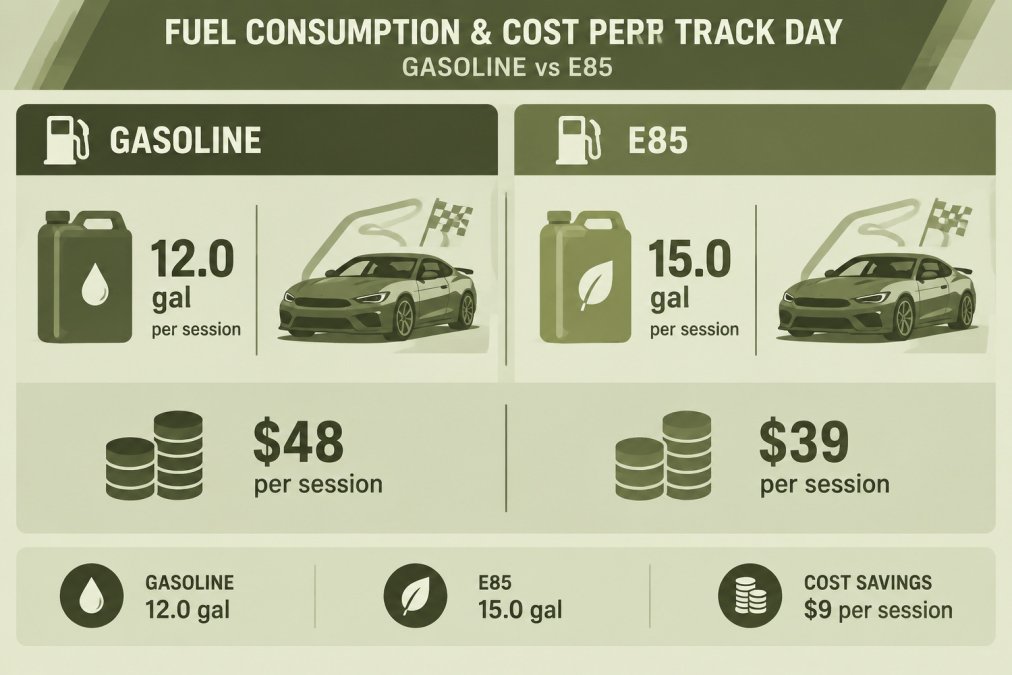
E85 Fuel Consumption Compared with Gasoline and Cost Per Track Day
E85 carries roughly 25 to 30 percent less energy per gallon than gasoline, so a car making the same power on E85 typically needs about 25 to 30 percent more fuel volume. That ratio is the single most useful number for planning a track day, because it drives tank range, how many sessions you can run between refuels, and how much fuel you need to bring or buy at the track.
A practical way to plan is to start from your gasoline baseline. If your car uses about half a tank per 20-minute session on pump gas, budget roughly 60 to 65 percent of a tank per session on E85, and plan to refuel or top off between sessions rather than stretching a tank across two. Most occasional track-day drivers find they need to carry or buy more fuel than they expected the first time they run E85, because the consumption penalty stacks with the higher load of sustained laps.
Cost per track day depends on the whole event, not just the pump price. Build the comparison in four lines:
- Fuel volume per event. Sessions per day times fuel per session, adjusted for the 25 to 30 percent E85 penalty.
- Price per gallon. Pump E85 is commonly priced below premium gasoline and well below race gas, though the gap varies by region and season.
- Travel to refuel. If the nearest E85 station is off-site, add the round trip, the time out of your day, and the fuel burned getting there. A trackside race gas drum avoids that trip but costs more per gallon.
- Conversion cost amortized over events. A flex-fuel sensor, larger injectors, and a higher-volume pump are one-time costs. Divide them by the number of events you actually run per season to see the true per-event premium.
Drivers who run only one or two events a year may find the conversion cost does not amortize, which can be a reason to stay on race gas.
The 25 to 30 percent figure is a general rule of thumb, not a guarantee, and a tune that adds boost and timing on E85 can push consumption higher.
Choosing the Right Fuel for Your Next Track Day
Choose E85 if you run occasionally, want to avoid race fuel costs, and are willing to install a properly sized fuel system with a flex sensor. Choose race gas if you run frequently in a dedicated car and prefer fixed fuel specs over blend variation.
Where to start: confirm your engine can run E85, size injectors and the pump for the power you target, and add a sensor so the ECU tracks the blend. Our team can help you match components to your setup. Browse our flex fuel products or see the fuel injector options for LS platforms to plan your build.


Get started with Advanced Fuel Dynamics and run E85 with confidence on your next track day.
Frequently Asked Questions
Is race gas better than E85?
It depends on the car and the goal. Race gas typically runs 110 octane and gives a car a high knock margin without changing the fuel system. E85 has a higher effective octane and cooling effect, so a car set up for it can make more power, but it needs more fuel volume and a tune that accounts for ethanol. For an occasional track day in a car that is not already built for E85, race gas is usually the simpler choice. For a truck or street car that already runs flex fuel hardware, E85 is often the more economical way to add power.
Does E85 make more power than 110 octane?
It can, but only when the engine is calibrated for it. E85 resists knock better than 110-octane race gas and its charge cooling lets the tune run more timing or boost. Without an E85 calibration, a car on E85 will not automatically gain power and may lean out. The gain comes from the combination of fuel, fuel system capacity and a tune built around ethanol content. Advanced Fuel Dynamics offers the GM/Continental E85 FlexFuel sensor at $59.00, the E-SENSE E85 Flex Fuel Content Sensor at $249.00, and the FlexLink E85 flex fuel kit for stand alone ECUs at $459.00.
Is pump E85 consistent enough for track use?
Pump E85 varies because ethanol content is not held to a single number at every station. The blend can drift between stations and between fill-ups, which changes the fuel the engine sees. For track use, this matters because the tune and fueling must stay correct across the session. A content sensor such as the E-SENSE E85 Flex Fuel Content Sensor reads the actual blend so the ECU can adjust, which reduces the risk of running a fuel that does not match the calibration.
What should you check before switching fuels for a track day?
Check that the fuel system can deliver the extra volume E85 requires, that the ECU has a flex or E85 calibration or sensor input, and that the ethanol content is known. Confirm the fuel pump capacity; the High Efficiency EFI in-line fuel pump at $827.60 is compatible with ethanol. Plan fuel supply for the event, and avoid mixing E85 with race gas in a tank that is not set up for both. Test the setup on the street before the track.
