

The Practical Alternative to Flex Fuel Kits for Trucks
November 08, 2026

Last Updated: November 8, 2026
Quick Summary
The practical alternative to flex fuel kits for trucks is a sensor-based system that reads ethanol content at the pump and adjusts fuel delivery in real time, so no custom calibration is needed. It keeps your truck drivable on gasoline, E85, or any blend.
- Sensor-based kits feed real-time ethanol content to the factory computer, letting existing flex logic handle the adjustment.
- Confirm your exact engine displacement, model year range, and injector capacity before buying any kit.
- Pump E85 content varies by station and season, so test a new station before filling and retest when the season changes.
- Ethanol absorbs moisture from the air, so keep the tank fuller during storage and check lines, seals, and tank compatibility.
- Plan your return leg first: real range on E85 is shorter, and a station open on the way out may be closed on the way back.
Ready to run E85 without a custom tune?Plug-and-play flex fuel systems for GM and RAM trucks, no tuning required.
Shop Flex Fuel Systems
Table of Contents
- Why Most Truck Owners Need a Different Kind of Flex Fuel Solution
- What a Truck Flex Fuel Kit Actually Does
- Choosing an E85 Conversion Kit for Trucks: Fitment, Fuel System, and Support
- E85 Tuning Requirements for Trucks: What You Can Skip and What You Can't
- Pump E85 Versus Race E85: Which One Belongs in Your Truck
- Comparing Plug-and-Play Flex Fuel Systems for Popular Trucks
- Matching a System to Your Truck and Driving Habits
- Frequently Asked Questions
Why Most Truck Owners Need a Different Kind of Flex Fuel Solution
The search for flex fuel kits for trucks usually starts the same way: a driver wants E85 power without handing their truck to a tuning shop for a week.
Most truck owners don't need a race calibration. They need a system that reads ethanol content at the pump and adjusts fuel delivery in real time.
That distinction matters. For a side-by-side look at skipping the tuning route, see our breakdown of E85 conversion kit alternatives that skip the tuning.
What a Truck Flex Fuel Kit Actually Does
A truck flex fuel kit is a hardware package that lets your engine run on gasoline, E85, or any blend of the two by measuring ethanol content and adjusting fuel delivery accordingly.
The confusion starts with terminology. E85 is a physical fuel blend; flex fuel describes the system that lets an engine adapt to it. Our guide on E85 versus flex fuel explains the distinction before you buy.
Sensor-Based Kits vs. Full Conversion Systems
Sensor-based kits read ethanol content and feed that data to the factory computer. Full conversion systems go further, managing injector behavior and fuel volume directly. The first suits stock trucks with existing flex mapping. The second suits trucks that need the system to do the thinking.
Choosing an E85 Conversion Kit for Trucks: Fitment, Fuel System, and Support
Fitment matters. An E85 conversion kit for trucks should match your engine, injector size, and fuel system capacity. Buy for the truck you own.
Start with three checks:
- Engine and year: Confirm the kit lists your exact displacement and model year range.
- Injector capacity: Stock injectors handle stock power; bigger cams or forced induction need more headroom, which is why matching fuel injectors for GM 2007-13 trucks with the 4.8, 5.3, and 6.0 or injectors for the 2009-13 6.2 matters before you add ethanol.
- Support: Ask what happens when a check engine light appears.
Watch out: buying a kit that assumes upgraded injectors when your truck is stock can lead to rich conditions and rough running.


E85 Tuning Requirements for Trucks: What You Can Skip and What You Can't
E85 tuning requirements for trucks come down to one question: does your ECU already understand ethanol? If it does, a sensor-based kit can feed it real-time content data and let the factory flex logic do the rest.
If your truck was never flex-fuel equipped, you either add a system that manages fuel delivery itself or pay a shop to write a calibration.
"No tuning required" does not mean "no fuel management."
Pump E85 Versus Race E85: Which One Belongs in Your Truck
Pump E85 versus race E85 is a question of consistency. Pump ethanol content varies by station and season; race E85 arrives in a sealed drum with a stated blend. Your fuel system has to cope with whichever you choose.
Why the Number at the Pump Is Not 85
E85 is a specification with a range, not a fixed ratio. Federal regulations allow seasonal variation, and many stations sell blends well below the 85% on the label during colder months, because lower ethanol content improves cold-start behavior.
The problem is a calibration that assumes a fixed percentage. Feed an 85%-built tune a blend closer to 70% and the mixture runs rich; go from a winter blend to a summer blend without adaptation and it leans out.
How to Test Ethanol Content Before You Trust a Station
You do not have to guess. A simple ethanol content test can separate the ethanol from the gasoline using a graduated tube and a small water sample. The procedure takes a few minutes:
- Fill the test tube to the marked line with fuel from the pump.
- Add water to the second marked line and cap the tube.
- Shake it, then let it settle until the layers separate.
Test a new station before you fill the tank, and test again when the season changes.
Watch out: a tune calibrated for one blend is not automatically safe on another. With a fixed calibration, test every fill and carry the test kit. With a content-sensing system, the sensor adapts, but you still want to know what you are buying.
What Race E85 Buys You, and What It Costs
Race E85 removes much of the variability. A sealed drum carries a stated blend, so the fuel that goes in the tank matches the fuel the calibration was built for.
It also removes the cost advantage: drum fuel carries a premium and adds handling and storage. For a truck that commutes, hauls, or sits between events, drum fuel is impractical.
Storage, Water, and What Ethanol Does Between Events
Ethanol is hygroscopic, meaning it absorbs moisture from the air. In a truck that sits for weeks, that water can separate from the fuel, cause running problems, and accelerate corrosion in components not designed for it. A few habits keep this manageable:
- Keep the tank fuller rather than emptier during storage, which limits the air space that moisture comes from.
- Avoid long storage on a winter blend if the truck will not be driven, and plan to burn through older fuel before adding fresh.
- Check fuel-system materials, including lines, seals, and the tank itself, for ethanol compatibility before committing to E85 as a steady diet.
For a street-driven truck, pump E85 is the practical answer, provided your system reads content in real time. For a dedicated track build, race E85 removes the variability and the cost advantage together. The right choice follows from how often the truck runs and who is calibrating.
Comparing Plug-and-Play Flex Fuel Systems for Popular Trucks
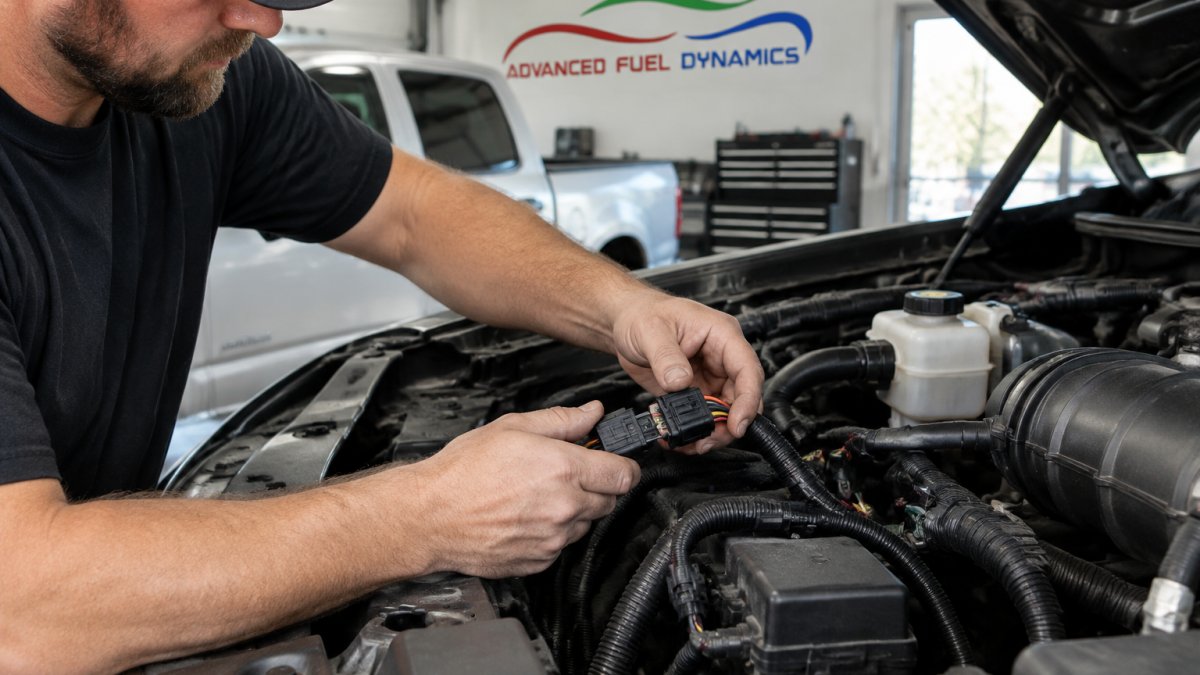
Here is how our systems line up by truck and by what the driver actually does with it.
| System | Fits | Price | Best For |
|---|---|---|---|
| ProFlex DXI | 2020-26 Silverado/Sierra HD 6.6L gas | $799 | Heavy-duty towing with E85 flexibility |
| ProFlex DXI | 2020-26 Silverado/Sierra 5.3L | $799 | Daily-driven half-ton trucks |
| FlexLink | 2014-19 Silverado/Sierra 5.3L, 6.2L | $399 | Owners who already have flex mapping and a tuner nearby |
| ProFlex Commander | 2008-13 Silverado/Sierra V8 | $899 | Older GM trucks with no factory flex logic |
| ProFlex Commander | 2006-present RAM 5.7 HEMI | $899 | HEMI owners running stock or lightly modified setups |
The ProFlex DXI for 2020-26 Silverado HD and Sierra HD 6.6L is the one we point heavy-duty owners toward: about 15 minutes to install, no tuning, invisible to scan tools.

Prices of plug-and-play flex fuel systems by truck
ProFlex DXI (2020-26 Silverado/Sierra HD 6.6L) $799
ProFlex DXI (2020-26 Silverado/Sierra 5.3L) $799
FlexLink (2014-19 Silverado/Sierra 5.3L, 6.2L) $399
ProFlex Commander (2008-13 Silverado/Sierra V8) $899
ProFlex Commander (2006-present RAM 5.7 HEMI) $899
Matching a System to Your Truck and Driving Habits
Match the system to your weekly routine, not a spec sheet. A truck that fills at the same station every week has different needs than one that tows across three states. Most buyers shop hardware first and driving pattern second, reverse that order.
Start With How Often You Will Actually Buy E85
Ask three questions before you look at a single kit. How often will you actually buy E85? Is there a station within your normal driving loop? Do you want to switch back to gas without thinking about it?
Occasional E85 use points to a sensor-based kit with real-time content reading. If you plan to build the engine later, buy the system that scales with injector upgrades rather than replacing it twice.
The Track-Day and Towing Math Nobody Shows You
Price per gallon is the least useful number in this decision. What matters is cost per session or cost per trip, and that figure includes more than fuel.
Ethanol carries less energy per gallon than gasoline, so a truck running E85 burns more of it to do the same work (Alternative Fuels Data Center: Ethanol Fuel Basics). Add the following to the ledger:
- Extra consumption: more gallons per mile, so more fill-ups per event or per tow.
- Travel to refuel: if the nearest tested E85 station is off your route, the detour is part of the cost.
- Conversion cost, amortized: the kit price spread across the events or miles you will actually run it. A system used twice a year carries a very different per-event cost than one used every weekend.
Run that math for your own truck and route before comparing kit prices. The cheapest kit is not the cheapest system if it forces a detour every fill or leaves you short on a long tow.
Fuel Planning and Reserve Logistics
Fuel availability is the failure point that ends more weekends than any hardware problem. A practical checklist:
- Confirm E85 availability along your actual route, not just near home, and note station hours.
- Carry a legal, safely stored reserve of gasoline for the return leg if the route has gaps.
- Know your truck's real range on E85, which is shorter than on gasoline, and plan fill-ups against that number.
Watch out: a truck that runs E85 and tows a trailer can burn through a tank faster than the driver expects, and a station that was open on the way out may be closed on the way back. Plan the return leg first.
Decision Guidance for Trucks That Also Commute
Most trucks are not dedicated builds. They commute on Monday, tow on Saturday, and sit in the driveway for a week after. That pattern changes the recommendation.
A truck that must also commute needs a system that adapts without a laptop or a tuner on call, real-time content sensing rather than a fixed calibration, because the blend will change between the commute fill and the event fill.
If you only run E85 occasionally, a sensor-based kit that lets the factory flex logic do the work is the low-friction choice.
The Pre-Order Checklist
- Confirm your engine displacement and model year against the fitment list
- Check whether your truck has factory flex mapping
- Decide whether you will upgrade injectors within the next year
Our ProFlex Commander product line is backed by a limited 12-month warranty.
Frequently Asked Questions
Can a truck run E85 without a flex-fuel conversion?
Only if it left the factory as a flex-fuel vehicle. A standard gasoline truck has no ethanol content sensor and no calibration to add the extra fuel volume E85 demands, so running it straight can push injector duty cycle and air-fuel ratio out of range. A plug-and-play flex fuel kit adds the sensor and the fuel management to handle blends safely, letting you fill with gas or E85 at any pump without a custom tune.
How do truck flex-fuel systems adjust to changing ethanol content?
They read the fuel in the line continuously and adjust fueling in real time. Systems like the ProFlex Commander use BlendSense technology with a 30 millisecond refresh rate, so when a pump delivers E70 instead of E85 the calibration follows within the same drive. That real-time correction is what separates a true flex fuel kit from a fixed E85 tune that assumes one ethanol percentage.
What should I check before installing an E85 conversion kit on a truck?
Confirm three things: fitment by year, engine and model; whether your factory injectors have the headroom for the extra fuel volume E85 requires; and whether the kit needs ECU activation at a tuning shop. The ProFlex DXI for 2020-26 Silverado and Sierra 5.3L and 6.6L models installs in about 15 minutes with no tuning, while the FlexLink kit for 2014-19 trucks requires a shop to flip the flex-fuel setting on the ECU after installation.
Does E85 require engine tuning in a truck?
Not with an adaptive flex fuel system. Older approaches required a dedicated E85 tune, which locked the truck to one fuel and meant reflashing to switch back. A plug-and-play kit manages injector pulse width itself, so it works with your stock calibration and adapts if you add a gas tune later. Custom tuning is only necessary for high-horsepower builds with forced induction or injectors 600cc and larger.
How can I tell whether a flex-fuel kit is compatible with my truck?
Match the kit's stated year range, engine displacement and model exactly, then check what else it needs. A complete system includes the ethanol sensor, fuel lines and harness with nothing else to buy. Watch for kits that require ECU activation, injector upgrades or a separate tuning session, since those add cost and downtime. When in doubt, contact the manufacturer with your VIN before ordering.
