

7 E85 Conversion Kit Alternatives That Skip the Tuning
October 31, 2026

Last Updated: November 1, 2026
Quick Summary
The best E85 conversion kit alternatives add hardware that reads ethanol content and adjusts fueling in real time, so the factory ECU calibration stays intact and no dyno tune is needed. A plug-and-play controller like the PROFLEX Commander suits daily drivers and trucks, while standalone ECU builds pair a flex fuel sensor kit with a flex map.
- A plug-and-play controller intercepts fuel delivery instead of rewriting the ECU calibration, so no dyno session is required.
- The FlexLink Stand Alone ECU kit costs $459.00 and ships with a genuine GM/Continental sensor, quick-connect lines, and harnesses.
- The E-SENSE sensor costs $249.00 and offers far higher flow plus temperature compensation versus the $59.00 GM/Continental unit.
- The FUELAB inline pump is rated to 1500 horsepower and flows 600 liters per hour at 45 PSI for $827.60.
- Break-even miles equal total upfront cost divided by the difference between gasoline and E85 cost per mile.
Table of Contents
- Why Drivers Look Beyond a Traditional E85 Conversion Kit
- Quick Comparison: Flex-Fuel Options at a Glance
- E85 Conversion Kit Without Tuning: How Plug-and-Play Systems Work
- Flex Fuel Sensor Kit Options for Standalone and Factory ECUs
- E85 Fuel System Upgrades: Pumps, Regulators, and Injector Headroom
- E85 Kit Vehicle Compatibility: What to Check Before You Buy
- Total Cost of Ownership and Break-Free Math
- Match the Kit to Your Goal: Daily Driver, Tow Rig, or Track Car
- Frequently Asked Questions
Why Drivers Look Beyond a Traditional E85 Conversion Kit
A traditional E85 conversion kit usually means a custom tune, a laptop, a dyno session, and a shop that knows your platform.
Ethanol carries more octane than premium gasoline, and a properly fed engine can run more ignition timing and make more torque (Alternative Fuels Data Center: Ethanol Benefits and Considerations).
That is the gap the best E85 conversion kit alternatives fill.
Quick Comparison: Flex-Fuel Options at a Glance
Every option below solves the same core problem but differs in how much control you keep and how much hardware you add.
| Option | Price | Tuning Required | Best For | Main Trade-off |
|---|---|---|---|---|
| PROFLEX Commander | Contact for pricing | No | Daily drivers, trucks, SUVs | Requires a supported vehicle platform |
| FlexLink Stand Alone ECU kit | $459.00 | Yes, flex map needed | Standalone ECU builds | Needs an ECU with a flex input |
| FlexLink Ethanol Gauge | $299.00 | No | Monitoring and data logging | Readout only, no fuel control |
| E-SENSE Content Sensor | $249.00 | No | High-flow fuel systems | Sensor only, needs an ECU to act on it |
| GM/Continental Sensor | $59.00 | No | Budget OEM-style builds | Flow restriction at high power |
| Fuel pump and injector upgrade | $827.60 and up | Yes | Big power builds | Adds cost and complexity |
| Blending E85 with pump gas | $0 | No | Mild experimentation | No adaptation to blend changes |
The cheapest options give the least control; the options that give real control without tuning are built around a dedicated controller.
E85 Conversion Kit Without Tuning: How Plug-and-Play Systems Work
An E85 conversion kit without tuning works by intercepting fuel delivery rather than rewriting the ECU calibration. A content sensor reads the ethanol blend, a controller translates that reading, and the fuel system delivers the volume the engine needs.
That is the idea behind our PROFLEX Commander. It sits between the factory ECU and the fuel system, reads ethanol content continuously, and adjusts delivery to match.
What the ECU Needs to See
The ECU needs two things to stay happy: a fuel composition signal it can interpret, and fuel pressure and volume that match what it expects. Get either wrong and you get lean conditions, rough cold starts, and drifting fuel trims.
If you want the install sequence laid out end to end, our guide to 7 DIY flex fuel sensor installation steps done right walks through the wiring, sensor placement, and verification checks in order.
Flex Fuel Sensor Kit Options for Standalone and Factory ECUs
A flex fuel sensor kit is the measurement layer of any conversion.
For standalone ECU builds, the FlexLink kit for standalone ECUs provides fuel content data to most popular platforms, including Holley, AEM, Haltech, Megasquirt, and FAST units with a flex fuel feature.
For builds that just need visibility, the FlexLink ethanol gauge module costs $299.00 and provides a Bluetooth readout through the ProFlex Connect app plus a wired 5-volt output for data logging, with a 30-millisecond refresh rate.
E-SENSE vs. the GM/Continental Sensor
The GM/Continental sensor is a genuine ethanol content sensor priced at $59.00, and it works with all major ECUs.
The E-SENSE sensor offers a massive flow rate compared with the GM/Continental unit, plus temperature compensation, a native 0-5 volt analyzer output, and modular fittings for 5/16-inch, 3/8-inch, and 1/2-inch quick connects plus -6AN through -12AN threaded connections. It costs $249.00.
In practice, the GM/Continental sensor suits a stock-ish build; the E-SENSE is right when flow restriction stands between you and your power target. You can view the E-SENSE E85 flex fuel content sensor for the full spec sheet.

E85 Fuel System Upgrades: Pumps, Regulators, and Injector Headroom
Ethanol requires more fuel volume than gasoline for the same energy, so the fuel system can become the limiting factor in a conversion.
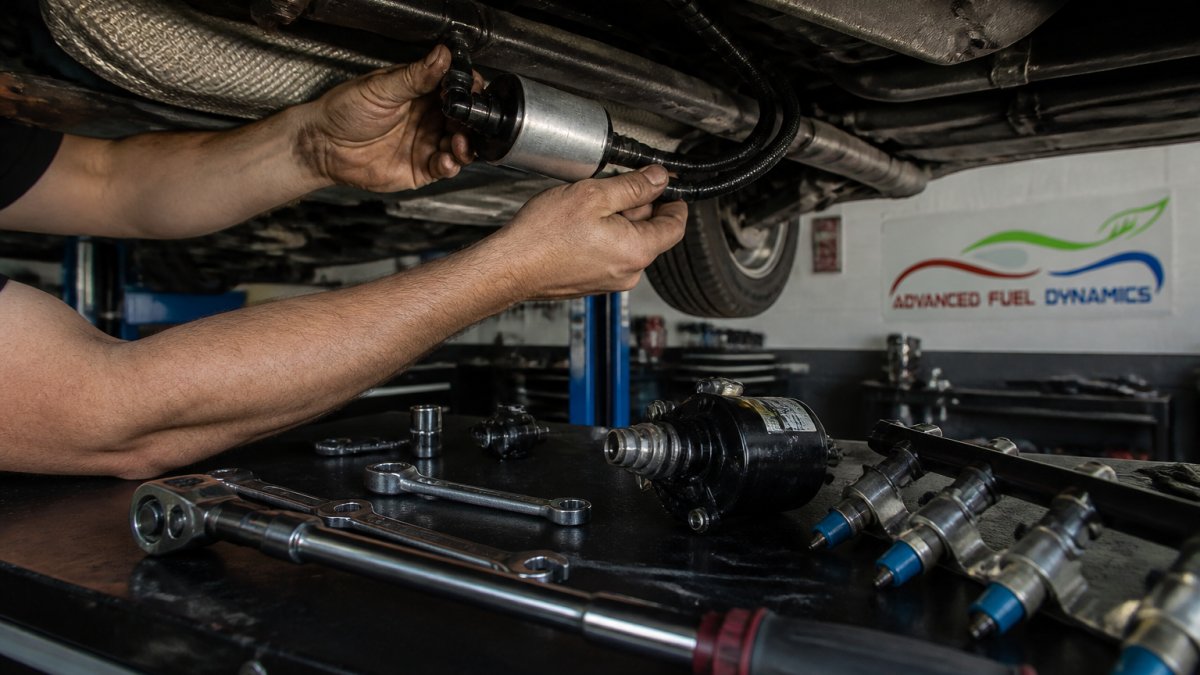
Start with injector headroom. If you are building a GM LS1 or LS6, browsing fuel injectors for GM LS1 and LS6 shows what capacity options exist for your displacement and power goal.
For high-horsepower builds, the FUELAB inline pump is rated up to 1500 horsepower, flows 600 liters per hour at 45 PSI, and is compatible with gasoline, diesel, methanol, and ethanol.

Pressure control matters just as much. The FUELAB electronic regulator costs $465.84 and offers demand-based flow control, works with ethanol, and includes an analog output for tracking actual system capacity.
E85 Kit Vehicle Compatibility: What to Check Before You Buy
E85 kit vehicle compatibility comes down to three questions: does your ECU support flex fuel logic, does your fuel system have the volume, and does the kit have a harness for your platform. Answer all three before you spend anything.
E-SENSE E85 Flex Fuel Content Sensor →
Start with the ECU. Factory flex-fuel-ready controllers are the easiest path.
Then check the fuel system. Stock lines and pumps handle moderate power on E85, but once you add boost or displacement, the pump and injectors become the limiting factor.
Finally, confirm the kit fits your chassis. For Camaro V8 owners, the E85 flex fuel collection for 2010-2015 Chevrolet Camaro V8 shows the vehicle-specific kit options so you can match the hardware to your car before ordering.
Compatibility Checklist by Vehicle and Engine
- Confirm your ECU has a flex fuel feature or a dedicated sensor input
- Verify your fuel pump can supply the extra volume E85 requires
- Check injector duty cycle at your target power level on E85
Total Cost of Ownership and Break-Free Math
Total cost of ownership for an E85 conversion is the kit price plus supporting hardware plus the tuning you avoid, minus the fuel savings you actually realize. That last term is where the real answer lives.
The Four Cost Buckets
- Conversion hardware. A plug-and-play controller, a flex fuel sensor kit, or a standalone flex input, the line item buyers focus on and the one that matters least over five years.
- Supporting fuel-system hardware. Lines, fittings, a fresh fuel filter, and, on higher-power builds, a pump and injector upgrade. Budget for these even if you do not install them on day one.
- Tuning you avoid (or pay for). A custom dyno tune is a recurring cost: initial session, revisions, and another session any time you change the combination. A plug-and-play controller trades that recurring spend for a single purchase.
- Fuel cost delta. E85 often prices below premium per gallon, but it usually delivers lower miles per gallon, so the fuel savings depend on local prices and mileage. Savings depend entirely on the local price spread and your annual mileage.
The Break-Even Formula
Break-even miles = Total upfront cost ÷ (Gasoline cost per mile − E85 cost per mile)
Where:
- Gasoline cost per mile = local premium price per gallon ÷ gasoline MPG
- E85 cost per mile = local E85 price per gallon ÷ E85 MPG
E85 MPG is generally lower than gasoline MPG on the same vehicle, because ethanol carries less energy per gallon (Alternative Fuels Data Center: Ethanol Fuel Basics). Plug in that penalty, not a guess.
A Worked Example
Suppose a driver covers 12,000 miles a year, premium gasoline runs $4.00 per gallon at 24 MPG, and E85 runs $2.80 per gallon at 18 MPG.
- Gasoline cost per mile: $4.00 ÷ 24 = about $0.167
- E85 cost per mile: $2.80 ÷ 18 = about $0.156
- Savings per mile: about $0.011
If the upfront cost is $1,500, break-even lands around 136,000 miles, longer than many owners keep the vehicle. If the local price spread is wider, say E85 at $2.20 against premium at $4.20, savings per mile roughly triple and break-even drops to under 50,000 miles.
Watch Out
Do not budget for the kit alone. Lines, fittings, and a fresh fuel filter are normal additions, and skipping them is how a clean install turns into a lean condition three months later. A lean condition is also the fastest way to turn a fuel savings into an engine replacement.
What the Math Does Not Capture
The break-even calculation ignores the octane benefit. Ethanol's higher octane lets a properly calibrated engine run more ignition timing, and on a forced-induction build that can mean more torque at the same boost, a performance return the fuel-savings math never shows. It also ignores resale and warranty considerations, which vary by platform.
Key Takeaway
Run the formula with your own local prices and your own annual mileage before you buy anything. If the spread is thin and your mileage is low, the honest answer may be that no conversion pays back, and that is worth knowing before you spend a dollar.
Match the Kit to Your Goal: Daily Driver, Tow Rig, or Track Car
The right choice depends entirely on what you are asking the vehicle to do. Use the decision framework below to match the approach to your goal, then confirm fitment before you order.
Decision Framework by Driver Goal
| Your goal | Best approach | Why | Watch out for |
|---|---|---|---|
| Lower fuel cost on a stock daily driver | Plug-and-play controller | Adapts to inconsistent pump blend without a tune | Confirm your platform is supported before buying |
| Occasional E85 use, mostly gasoline | Plug-and-play controller or content gauge | Handles blend changes automatically; gauge gives visibility | A gauge alone does not adjust fueling |
| Added power on a boosted build | Standalone ECU with flex input plus high-flow sensor | Full control over timing and fueling across blends | Needs a flex map and injector headroom |
| Towing and sustained load | Fuel-system headroom first, then controller | Protects against lean conditions under load | Upgrade pump and regulator before adding power |
| Track or race use | Standalone ECU, high-flow sensor, full fuel-system upgrade | Maximum flow and data resolution | Budget for tuning revisions and spares |
| Preserving a stock daily driver | Content gauge for monitoring only | No calibration changes, no risk to factory logic | Readout only, no fuel control |
Daily Drivers and Trucks
A plug-and-play controller is the obvious pick. It adapts to inconsistent ethanol content at the pump, which matters because the blend at the station down the street is not the blend across town.
Before you commit, verify three things: your platform is supported, your fuel pump has volume margin, and your injectors have duty-cycle headroom at your target power. If any of those is a no, fix it first.
Tow Rigs
Add fuel-system headroom before you add power. A pump and regulator upgrade protects the engine from lean conditions under sustained load, and towing is the worst case for fuel demand because you are at high load for long stretches. Size the pump for the worst case, not the commute.
Track Cars
The standalone ECU route with a flex fuel sensor kit and a high-flow sensor gives you the flow and the data resolution a race calibration needs. Our products are tested in house and through third-party testing.
When Not to Convert
Watch Out
If your vehicle is not supported, your fuel system has no margin, or your annual mileage is low and the local price spread is thin, the honest answer is to wait. Running E85 on an unsupported calibration can push the engine lean, and no fuel savings justify an engine replacement.
Key Takeaway
Pick your goal first, then pick the hardware that meets it. The goal decides the approach; the vehicle decides whether the approach is safe.
Frequently Asked Questions
Can an E85 conversion kit work without tuning?
Yes, if the kit handles fuel content on its own. A plug-and-play system reads ethanol content through a flex fuel sensor and adjusts fuel delivery in real time, so you are not flashing a custom calibration for every tank. The catch is that the vehicle still needs injector and pump headroom for the extra volume E85 demands. Confirm fitment with the manufacturer before buying, and check that your factory ECU accepts the sensor signal.
Does a car need upgraded fuel injectors or a fuel pump to run E85?
E85 requires more fuel volume than gasoline for the same power, so injector duty cycle and pump flow become the limiting factors. Many stock systems run out of injector capacity before anything else. A fuel pump rated for ethanol, like a 600 LPH brushless unit, plus a regulator that holds pressure under demand, keeps the system stable. Check injector capacity and pump flow before adding ethanol.
How do flex-fuel conversion kits adjust to changing ethanol content?
A fuel composition sensor measures the ethanol percentage in the line and sends that data to a controller or directly to the ECU. The controller converts the reading into a signal the engine management system understands, and fuel trims and ignition timing shift to match. Because pump E85 varies by season and station, a sensor that refreshes quickly and compensates for fuel temperature keeps the air-fuel ratio consistent tank to tank.
Can any gasoline car be converted to run E85?
No. E85 kit vehicle compatibility depends on the ECU accepting a flex signal, the fuel system using ethanol-compatible materials, and enough injector and pump capacity. Port-injected engines are generally simpler than direct-injection setups. Vehicles with factory flex-fuel support need only a sensor and gauge in many cases. Verify your engine code and ECU strategy with the kit maker before ordering, and confirm fuel line and seal materials are rated for ethanol.
Will an E85 conversion kit increase engine power?
E85 carries a higher octane rating, which lets an engine run more ignition timing before knock, and that is where the power comes from. Gains depend on the calibration and the engine, so expect modest results on a stock tune and larger numbers when timing is optimized. A wideband oxygen sensor and data logging help confirm the air-fuel ratio stays safe.
The challenge is not deciding whether E85 is worth it. It is choosing a conversion path that does not turn into a tuning project. Advanced Fuel Dynamics builds plug-and-play flex fuel systems that read ethanol content at the pump and adjust fuel delivery in real time, with no tuning required, DIY-friendly installation, and dynamically flow-matched delivery that stays consistent as the blend changes. Get started with Advanced Fuel Dynamics and put ethanol to work in your vehicle this weekend.
