

5 Best Ethanol Fuel Upgrades for Daily Drivers That Work
November 02, 2026

Last Updated: November 2, 2026
Quick Summary
The best ethanol fuel upgrades for daily drivers are adaptive flex fuel systems that read ethanol content in real time and adjust fueling automatically, like the ProFlex DX for 2018-23 Mustang GT and Mach 1, which installs in about an hour with no tuning and delivers 40-45 WHP on E85. Supporting hardware such as E85-compatible injectors and pumps is the other path when your power target exceeds stock fuel system capacity.
- ProFlex DX fits 2018-23 Mustang GT and Mach 1 and installs in about an hour with no tuning.
- ProFlex Commander fits 3.6L Pentastar V6 vehicles and adds 7-10% wheel horsepower on E85.
- FlexLink is a flex fuel sensor kit that requires a shop visit to activate the ECU flex setting.
- An E85 conversion kit needs a custom tune and is not truly adaptive to blend swings at the pump.
- Match the in-tank EFI pump to your realistic power target, not your dream target.
Table of Contents
- Comparison Table: Five Ethanol Fuel Upgrades at a Glance
- 1. ProFlex DX for 2018-23 5.0L Mustang GT and Mach 1
- 2. ProFlex Commander for 3.6L Pentastar V6 Vehicles
- 3. FlexLink: The Flex Fuel Sensor Kit for Factory Flex-Fuel ECUs
- 4. When an E85 Conversion Kit for Daily Driver Duty Makes Sense
- 5. Supporting Hardware: E85-Compatible Fuel Injectors and Fuel Pump Upgrades
- Additives vs. Hardware Upgrades: Where Fuel Treatments Fit in a Daily Driver
- Choosing the Right Ethanol Fuel Upgrade for Your Vehicle
- Frequently Asked Questions
Comparison Table: Five Ethanol Fuel Upgrades at a Glance
Ethanol fuel upgrades for daily drivers fall into two camps: adaptive flex fuel systems that manage fueling in real time, and supporting hardware that keeps the fuel system fed. At Advanced Fuel Dynamics, we build the first category. The table below shows how the five options in this guide compare on fitment, install effort, and what each one actually delivers.
| Upgrade | Vehicle Fitment | Tuning Required | Install Time | Expected Gain on E85 |
|---|---|---|---|---|
| ProFlex DX | 2018-23 Mustang GT / Mach 1 | None | About 1 hour | 40-45 WHP |
| ProFlex Commander | 3.6L Pentastar V6 vehicles | None | Under 1 hour | 7-10% wheel HP |
| FlexLink | V6 Camaro, stand-alone ECU builds | ECU activation | 1-2 hours | 7-8% wheel HP |
| E85 conversion kit | Universal, vehicle-dependent | Usually required | Varies | Varies by tune |
| Injectors + pump | Universal, matched to power goal | Required | 3-6 hours | Supports existing gains |
The distinction that matters most: the first three rows adjust fueling automatically as ethanol content changes at the pump. The last two rows are hardware that must be paired with proper calibration.
1. ProFlex DX for 2018-23 5.0L Mustang GT and Mach 1
Our top pick for Mustang owners is the ProFlex DX, a patented adaptive flex fuel system built specifically for the dual-injection 5.0L Coyote. It installs in about an hour with no tuning, and we rate it for 40-45 WHP gains on E85. The system was developed through street, track, and dyno testing.

What separates it from a generic E85 conversion kit for daily driver use is BlendSense technology. It reads ethanol content in real time with a 30-millisecond refresh rate, so you can fill up on gas, E85, or any mix and drive away. No buttons, no reflash, no guessing.
Pros: True plug-and-play, no tuning, handles inconsistent pump ethanol. Cons: Professional install is wise if you are not comfortable with wiring.
Best for: Daily-driven S550 Mustang GT and Mach 1 owners who want flex fuel without a custom tune. Skip if: Your car already runs a stand-alone ECU with its own flex mapping.
2. ProFlex Commander for 3.6L Pentastar V6 Vehicles
Pentastar owners get the same adaptive approach in the ProFlex Commander, which fits the Jeep Wrangler JL and JLU, Gladiator JT, Dodge Charger and Challenger V6, Chrysler 300, and Dodge Durango.
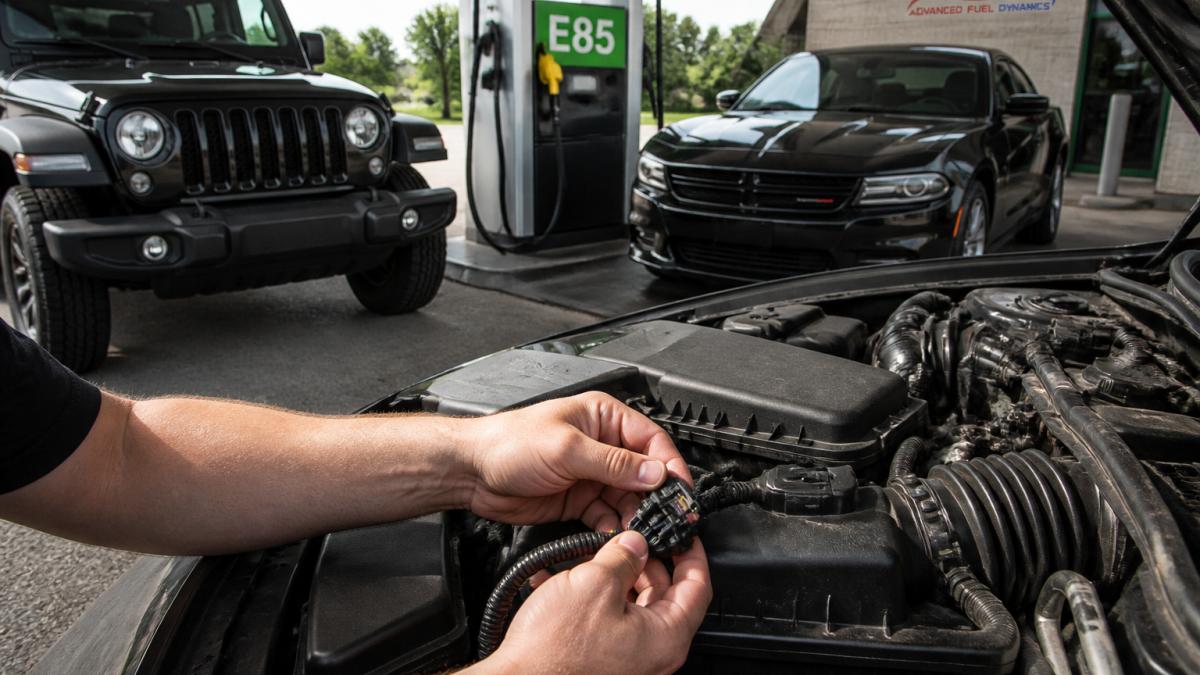
Expect 7-10% more wheel horsepower and torque on E85, plus cooler cylinder, oil, and coolant temperatures. The ProFlex Connect app shows live ethanol content on your phone, and Cold Start Plus improves atomization on cold mornings.
Pros: Broad V6 fitment, DIY-friendly, works with stock or performance gas tunes. Cons: Gains are modest compared with larger-displacement platforms.
Best for: Stock or lightly modified Pentastar daily drivers. Skip if: You want big forced-induction numbers without supporting fuel system work.
3. FlexLink: The Flex Fuel Sensor Kit for Factory Flex-Fuel ECUs
Some vehicles already have flex fuel mapping sitting dormant in the ECU. FlexLink is a flex fuel sensor kit that feeds real ethanol content data to that existing mapping, so you can run E85 and switch back anytime.
After installation, a tuning shop must activate the flex setting on your ECU. Naturally aspirated cars see roughly 7-8% wheel HP gains; forced induction builds see 9-10%. The stand-alone ECU version is compatible with a range of stand-alone ECUs, including Holley, AEM, and Haltech, depending on the ECU's flex fuel feature.
Pros: Lower cost than a full system, real-time content via the ProFlex Connect app, 5v output for data logging. Cons: Requires a shop visit for ECU activation; only works where factory flex mapping exists.
Best for: V6 Camaro owners and stand-alone ECU builds with existing flex capability. Skip if: Your ECU has no flex fuel feature at all.
4. When an E85 Conversion Kit for Daily Driver Duty Makes Sense
An E85 conversion kit for daily driver use makes sense when your platform has no factory flex mapping, no drop-in adaptive system, and no stand-alone ECU.
A typical conversion kit bundles four things: a flex fuel content sensor, a wiring harness that feeds that signal to the ECU, ethanol-compatible fuel lines and fittings, and sometimes a set of larger injectors. What it does not bundle is calibration. The tune is what makes the kit work, and the tune is also where daily-driver compromises show up.
ProFlex DX for 2018-23 5.0L Mustang GT and Mach 1 E85 Flex Fuel System →
Here is the honest trade-off. If ethanol content swings between pumps, and it does, because pump E85 commonly tests anywhere from about E51 to E83 depending on the season and the station, the calibration has to be conservative or revised (Alternative Fuels Data Center: E85 Flex Fuel Specification).
Before you buy any kit, run these checks:
- Confirm your vehicle is not already flex-fuel capable. Some vehicles left the factory with flex-fuel mapping dormant in the ECU. If yours is one of them, a sensor kit is cheaper and simpler than a full conversion.
- Check the owner's manual and fuel door for approved ethanol limits. Many standard gasoline vehicles are approved for E15 only, not E85. Running E85 in a vehicle not rated for it is a fitment and safety question, not just a tuning question.
- Verify injector duty cycle and pump capacity before the tune. A conversion kit installed without confirming both can lean out under load, and that is how engines get damaged.
- Inspect seals, hoses, and the fuel tank for ethanol compatibility. Older vehicles may have rubber components that degrade faster on high-ethanol blends. Long-term maintenance on a converted daily driver means watching for seepage, hardened lines, and corrosion at fittings.
Watch out: a conversion kit sold without a content sensor is not a flex-fuel conversion, it is a fixed E85 tune, and it will not tolerate blend swings at the pump.
Best for: Enthusiasts with a platform that has no adaptive option, a consistent E85 source, and a willingness to have the calibration revised if blend changes. Skip if: You want to fill up on whatever blend is available without thinking about it, an adaptive system is the cleaner daily-driver answer.
5. Supporting Hardware: E85-Compatible Fuel Injectors and Fuel Pump Upgrades
Hardware is where most E85 plans stall. If you are planning an E85 upgrade on a 5.0L Mustang, the matching fuel injectors complete the hardware side of the build.
E85 Fuel Pump Upgrade: When the Stock Pump Becomes the Limit
For a daily driver pushing past stock capacity, an in-tank EFI pump rated to 625hp covers mild builds. A moderate build fits the 850hp-rated pump. High-horsepower daily drivers should look at the 1250hp option to avoid running out of fuel. Match the pump to your realistic target, not your dream target, an oversized pump on a stock fuel system can heat the fuel and shorten pump life.
Injectors: Size for Duty Cycle, Not Just Flow
Injectors 600cc and larger are the step-up point for forced-induction Pentastar builds, which is why the Commander Pro version is offered for that use case.
Long-Term Material and Maintenance Considerations
Ethanol is hygroscopic, it absorbs moisture from the air, and that has real maintenance implications for a daily driver. Water contamination in the tank can lead to phase separation, where the ethanol-water mix drops out of suspension and the fuel no longer burns predictably. Seals, hoses, and corrosion at fittings deserve periodic inspection on any converted vehicle, especially older platforms. No single treatment prevents every ethanol-related issue; the practical routine is to keep the fuel system sealed, avoid long storage with a partial tank, and inspect lines and fittings at service intervals.
Best for: Any build where the power target exceeds what the stock fuel system can support on E85. Skip if: Your stock injectors and pump already hold safe duty cycle and pressure on the blend you run, hardware without a need is money spent for no gain.
Additives vs. Hardware Upgrades: Where Fuel Treatments Fit in a Daily Driver
Hardware and adaptive systems address fueling: injector size, pump flow, and real-time ethanol compensation. If your engine has a rough idle or lean condition on E85, an additive will not correct it. A fuel treatment belongs in your routine for a high-mileage vehicle or a car that sits, not in your plan for making power.
Choosing the Right Ethanol Fuel Upgrade for Your Vehicle
Match the upgrade to what your ECU can already do. If your platform has factory flex mapping, a sensor kit is the cheapest route. If it does not, an adaptive system is the cleanest path for a daily driver. If you are chasing a specific power number, size the injectors and pump first.
We built our reputation on in-house dyno testing, multiple patents, and SEMA awards, and our customers drive millions of miles a month with our systems. The right ethanol fuel upgrades are the ones matched to your platform, not the biggest kit on the shelf.
Frequently Asked Questions
What upgrades are needed to run E85 in a daily driver?
It depends on the vehicle. Some factory flex-fuel cars only need a flex fuel sensor kit like FlexLink to read ethanol content, plus activation of the flex mapping already in the ECU. Vehicles not built for E85 typically need an adaptive flex fuel system that manages fuel delivery in real time, and modified or forced-induction builds may also need E85-compatible fuel injectors and an E85 fuel pump upgrade. Start by confirming your ECU and fuel system can support the blend you plan to run.
Can a daily driver run E85 without an engine tune?
Yes, with the right hardware. Adaptive systems such as the ProFlex DX and ProFlex Commander adjust fuel delivery in real time as ethanol content changes at the pump, so no custom tune is required.
Does E85 increase horsepower in a stock vehicle?
It can. E85 carries a higher octane rating than pump gasoline, which lets the engine run more timing before knock. Listed expectations for these systems include about 20-25WHP on a V6 Durango, 40-45WHP on a 5.0L Mustang GT, and 7-10% more wheel horsepower and torque on Pentastar V6 applications. Actual results vary by vehicle, supporting modifications, and the ethanol content of the fuel you buy.
Does E85 reduce fuel economy, and is the conversion worth it?
E85 contains less energy per gallon than gasoline, so you will burn more of it per mile. The offset is that E85 usually costs less at the pump and delivers more power and cooler cylinder, oil, and coolant temperatures. Whether it pays off depends on local E85 pricing and how you drive. For many daily drivers, the performance and cooling benefits matter more than the mileage difference.
Can you switch between gasoline and E85 with a flex-fuel system?
With a true adaptive flex fuel system, yes. Patented BlendSense technology refreshes ethanol content readings every 30 milliseconds, so you can fill up with gas, E85, or any mix and drive away with no buttons to press or settings to change. A sensor-only kit like FlexLink also supports switching, but it relies on flex mapping already present in your ECU and may need a tuning shop to activate that setting.
Your daily driver should not need a laptop and a tuner on speed dial to run E85. Advanced Fuel Dynamics builds plug-and-play flex fuel systems with BlendSense real-time ethanol sensing, Cold Start Plus for winter starts, and the ProFlex Connect app for live content readings. Get started with Advanced Fuel Dynamics and run E85 without the tuning headache.
