

Fuel Injectors for E85 Track Day Builds: Sizing Guide
November 15, 2026

Last Updated: November 15, 2026
Quick Summary
Size E85 track injectors so duty cycle stays at or below 90% at peak power, since E85 needs roughly 30% more fuel volume than gasoline. A naturally aspirated 450 hp example needs about 41 lb/hr per injector, while a boosted 550 hp build should use a 65 to 72 lb/hr set. Add headroom for heat and longer sessions.
- E85 carries less energy per gallon, so the engine needs roughly 30% more fuel volume than gasoline for the same power.
- Use a 90% duty-cycle ceiling and aim for 75 to 85% at peak power on a track car.
- The 450 wheel hp naturally aspirated example lands at about 41 lb/hr per injector across eight injectors.
- Boosted 550 wheel hp builds should use a 65 to 72 lb/hr set for track headroom.
- Log fuel pressure and pump voltage through a session-length run, not just a single pull.
Table of Contents
- Why E85 Track Builds Need Different Injector Planning
- E85 Injector Sizing by Horsepower and Duty Cycle
- E85-Compatible Fuel Injectors: Materials, Flow Data and Ethanol Variation
- Flex-Fuel Injectors for E85 and Changing Ethanol Content
- E85 Injectors for LS Engines: Fuel Pump and Pressure Considerations
- Validating Your Fuel System Before the Track Day
- Choosing Your Injector Set and Next Steps
- Frequently Asked Questions
Why E85 Track Builds Need Different Injector Planning
Injector planning for an E85 track car starts with a simple fact: ethanol carries less energy per gallon than gasoline, so the engine needs more fuel to make the same power.
Track sessions are harder on fuel systems than street driving.
Most E85 injector problems come from undersizing. A set near 100% duty cycle has no reserve, and any pressure drop or richer blend at the pump leads to a lean condition.
E85 Injector Sizing by Horsepower and Duty Cycle
Injector sizing starts with the power target and the duty cycle you want at that target. Our charts are expressed in wheel horsepower and assume stock fuel pressure and 90% duty cycle operation.
The basic approach has four steps:
- Set a realistic wheel horsepower goal for the engine.
- Convert that power into required fuel flow, using E85's higher volume requirement.
- Divide by your duty-cycle ceiling to find the flow the injector set must deliver.
- Divide by the number of injectors to get the per-injector flow rate, then pick the next size up.
Duty cycle is the percentage of each engine cycle the injector is open. At 90%, the injector has only 10% of its time left to spare. Running at 100% means the injector cannot deliver more fuel, so any extra demand goes unmet.
The Math Behind the Chart
A useful rule of thumb for gasoline is roughly 0.50 lb of fuel per horsepower-hour for a typical naturally aspirated engine, and 0.55-0.60 lb/hp-hr for a boosted engine under sustained load.
From there, divide by the duty-cycle ceiling (0.90) to leave headroom, then divide by the number of injectors. That final number is the per-injector flow rate at your base fuel pressure.
Worked Example: Sizing Injectors for a Naturally Aspirated Track Car
Consider a naturally aspirated V8 targeting 450 wheel horsepower on E85 for occasional track days. Naturally aspirated engines have a predictable load profile, so the calculation is straightforward.
- Target power: 450 wheel horsepower
- Assumed BSFC on E85: about 0.65 lb/hp-hr (gasoline figure of ~0.50 scaled for E85's higher volume requirement)
- Total fuel mass flow: 450 × 0.65 = 292.5 lb/hr
A 42 lb/hr injector set at 43.5 psi base pressure lands right at the 90% ceiling for this build. Because E85 needs roughly 30% more fuel volume than gasoline for the same power, check the chart for the E85 power rating rather than the gasoline figure. Our injector sets are dynamically flow matched as a set to support balanced fueling.
Worked Example: Sizing Injectors for a Boosted Track Car
Boosted engines need more care. Boost increases airflow, which means more fuel for each cycle. A turbocharged or supercharged track car making 550 wheel horsepower on E85 should be sized against the boosted power target, not the naturally aspirated equivalent.
- Target power: 550 wheel horsepower under boost
- Assumed BSFC on E85 under boost: about 0.75 lb/hp-hr (boost raises fuel demand per horsepower)
- Total fuel mass flow: 550 × 0.75 = 412.5 lb/hr
A 60 lb/hr set at 43.5 psi base pressure sits near the ceiling here, so a 65-72 lb/hr set gives the headroom a track car needs. Confirm the regulator holds pressure as boost rises, because injector flow depends on the pressure differential across the injector, a rising-rate or boost-referenced regulator changes effective flow and must be accounted for. Sustained boost on a track is where undersized injectors fail first, so size for the peak power you will actually run and leave room for heat and longer sessions.
Adjusting for Fuel Pressure and Blend
If your base pressure is higher than 43.5 psi, the injector flows more. Flow scales with the square root of the pressure ratio: a 50 lb/hr injector at 43.5 psi flows about 53.6 lb/hr at 50 psi (50 × √(50/43.5)). Lower base pressure reduces flow the same way. If the pump delivers E70 instead of E85, the fuel carries slightly more energy per gallon, so required volume drops a few percent, but size for the richest blend you expect to run, because a lean condition under load is what damages engines.
Watch out: sizing at exactly your peak power with no headroom means a single hot session, a slightly richer blend, or a small pressure drop pushes the injectors past 90% and into a lean condition.
The steps below summarise how the sizing calculation works and the figures used in the worked examples.
| Item | Value | Note |
|---|---|---|
| Target duty cycle ceiling | 90% | Leaves a 10% cushion for track demand |
| Naturally aspirated example target | 450 wheel hp | Eight injectors, about 41 lb/hr each |
| Boosted example target | 550 wheel hp | Set of 65-72 lb/hr recommended |
| E85 vs gasoline volume | About 30% more | Same power needs more fuel volume |
| E85 density | About 6.6 lb/gal | Gasoline is roughly 6.1 lb/gal |
| Base flow rating pressure | 43.5 psi (3 bar) | Scale flow if base pressure differs |
| Flow change with pressure | Square root of pressure ratio | 50 lb/hr at 43.5 psi flows about 53.6 lb/hr at 50 psi |
| Track peak duty cycle target | 75-85% | Preferred range for track reserve |
E85-Compatible Fuel Injectors: Materials, Flow Data and Ethanol Variation
E85 is more corrosive and more conductive than gasoline, so injector materials matter. Choose injectors built for ethanol compatibility, with corrosion-resistant internals.
Ethanol content also varies. E85 is nominally 85% ethanol, but the actual blend at the pump can shift, and flex-fuel conditions change how much fuel the engine needs. An injector set sized for one blend may run lean on another.
Flex-Fuel Injectors for E85 and Changing Ethanol Content
If you run both E85 and gasoline, or buy from pumps with different blends, flex-fuel capability becomes important. A system that cannot adjust to changing ethanol content can leave you running lean on a richer blend, or wasting fuel on a leaner one.
Our PROFLEX Commander dynamically adjusts to inconsistent ethanol content at the pump, ensuring consistent, balanced fuel delivery. For a track car that sees varied fuel, this adaptive control protects the engine across sessions.
E85 Injectors for LS Engines: Fuel Pump and Pressure Considerations
LS engines are a common E85 track platform, and they need a fuel pump and pressure setup that matches the injector flow. Injectors can only deliver what the pump and regulator supply.
For LS builds, plan the pump and surge tank together with the injectors. A surge tank keeps fuel supplied during hard cornering and sustained acceleration, which matters on a track.
Validating Your Fuel System Before the Track Day
A dyno pull lasts a few seconds. A track session lasts 15-30 minutes of repeated full-throttle runs, hard braking, and high-g cornering, and the fuel system sees conditions a street log never reproduces. Validation has to be built around sustained load, not a single peak-power pull.
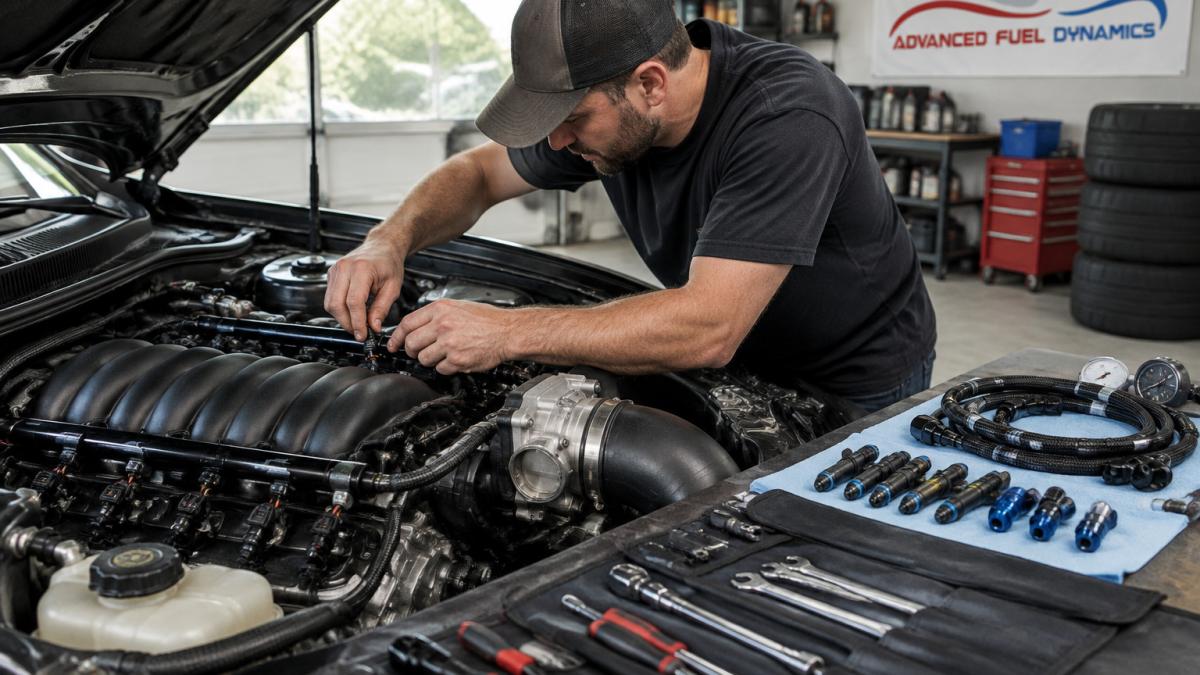
Step 1: Confirm the Sizing Math Against Your Log
Before anything else, log a full-throttle pull in third or fourth gear and confirm injector duty cycle at peak power. If the log shows duty cycle above 90% at your target boost or rpm, the set is undersized for track use regardless of what the chart says. Most practitioners target 75-85% at peak power on a track car so there is reserve for heat, a richer blend, and any future airflow mods.
Step 2: Validate Fuel Pressure Under Sustained Load
Fuel pressure is the variable that fails first on track. A pump that holds 58 psi at idle can sag to 45 psi after ten minutes of sustained load as fuel temperature rises and pump voltage drops. Log fuel pressure (or fuel pressure differential, if your ECU supports it) through a full session-length run, not a single pull. A drop of more than a few psi at peak load means the pump, wiring, or regulator is marginal.
Step 3: Watch Fuel Temperature and Tank Level
E85 absorbs heat and its vapor pressure behavior differs from gasoline, so fuel temperature matters more on a track car. Log fuel temperature if you have a sensor; if not, at minimum keep the tank above half full during sessions. Low tank level plus high-g cornering is the classic recipe for fuel starvation: the pickup uncovers, the pump ingests air, pressure drops, and the engine goes lean for a moment, often just long enough to hurt a piston.
Step 4: Confirm Ethanol Content and Tune Compensation
Test the ethanol content of the fuel you will actually run, not the pump label. E85 at the pump can range from roughly E51 to E83 depending on season and region, and a tune built for E85 run on E70 will be rich, while a tune built for E70 run on E85 can be lean. If you run a flex-fuel sensor and ECU compensation, log ethanol content and confirm the ECU is trimming fuel correctly across the range.
Step 5: Pre-Track Checklist
- Confirm injector duty cycle at peak power is at or below 90% (75-85% preferred for track)
- Log fuel pressure through a sustained-load run, not just a single pull
- Check pump voltage at the connector under load
Watch out: a set sized at exactly your peak power has no margin. Track heat, a richer blend, and longer sessions will push it past its limit, so size with the 90% ceiling in mind and validate on track, not just on the dyno.
Choosing Your Injector Set and Next Steps
Start with your power target and blend, size the injectors to keep duty cycle at or below 90%, and plan the pump, regulator and surge tank around them.
For a direct comparison of E85 and race gas before you commit to an injector setup, read our E85 vs Race Gas for Occasional Track Days Compared guide. Once you know your target, electronic external DC brushless fuel pump controller with variable speed input helps hold pressure steady under E85 demand.
For LS builders sizing the pump for E85 flow, surge tank system matched to your horsepower target and adjustable fuel pressure regulator covering the EFI range complete the setup.
Contact Advanced Fuel Dynamics with your power target and engine details, and our team can help you choose the right injector set for your track build.
Frequently Asked Questions
What size injectors do I need to run E85?
The right size depends on your target wheel horsepower, your fuel system's pressure, and the duty cycle you plan to run. Because E85 contains about 85% ethanol, it requires roughly 30% more fuel volume than gasoline for the same power, so an injector that works on pump gas will often run out of capacity on E85. Size for your power goal at roughly 90% duty cycle to leave headroom for sustained track sessions. Advanced Fuel Dynamics publishes horsepower charts for each injector set, so start there and confirm the final choice with your tuner.
Do you need special injectors to run E85?
Injectors used with E85 should be compatible with ethanol and sized with enough flow to cover the higher fuel demand. Standard gasoline injectors can run E85 in some cases, but they frequently run lean at high load. Advanced Fuel Dynamics offers injector sets that are dynamically flow matched as a set, which helps keep cylinder-to-cylinder fueling balanced for performance use. Check the listing for your application before buying.
Is E85 hard on fuel injectors?
E85 is not inherently destructive to properly specified injectors, but the bigger risk is running too little fuel capacity. Under-sized injectors on E85 can drive the engine lean under load, which causes heat and detonation risk on track. Choose injector materials and sizing designed for ethanol, keep fuel pressure stable, and monitor air-fuel ratio during validation runs.
How do I size injectors for an E85 track car?
Start with your target wheel horsepower, then work backward using the injector flow rating and a maximum duty cycle near 90%. Use the manufacturer horsepower chart as a cross-check, and remember that sustained track sessions load the fuel system longer than a drag pass. Build in a cushion so the injectors never approach full duty cycle during a hot lap session.
